Parler du passé
Le passé est utilisé pour décrire une action ou un événement qui s'est produit dans le passé. La façon la plus courante de former le passé est d'ajouter ed à la fin d'un verbe, ou d si le verbe se termine par e. Par exemple, le passé de walk est walked. Il existe de nombreux verbes irréguliers en anglais et ils sont abordés dans les leçons suivantes.
| Verb | Past Tense | |
|---|---|---|
| ask | asked | demander |
| decide | decided | decider |
| help | helped | aider |
| like | liked | aimer |
| live | lived | vivre |
| move | moved | déplacer, bouger, transporter |
| open | opened | ouvrir |
| show | showed | montrer, démontrer |
| talk | talked | parler |
| want | wanted | vouloir |
Examples
 She talked about her vacation.
|
Elle a parlé de ses vacances. |
|
He closed the door.
|
Il a fermé la porte. |
|
We hoped for the best.
|
Nous espérions le meilleur. |
|
The clouds drifted away.
|
Les nuages se sont éloignés. |
Annonce
Conversations
English
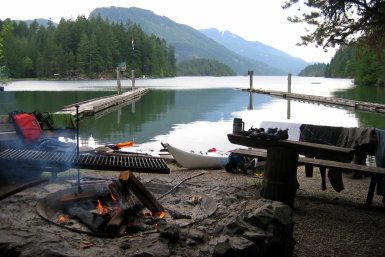
Eric phones Tom to tell him about his vacation at a nearby lake.
Eric: Hi Tom. How's it going?
Tom: Good. How was your vacation?
Eric: Great! We went hiking in the forest, and kayaking around the lake. We were very lucky with the weather, it was sunny and warm every day.
Tom: How many people were there?
Eric: There were five of us.
Tom: Where did you stay?
Eric: We rented a cabin at the south end of the lake. It was right on the lake, with a small beach in front. It came with a kayak and wood for the fire pit on the beach. I had such a great time that I want to go again next summer. Maybe you can come with us next time.
Tom: That sounds great!
Français
Eric téléphone à Tom pour lui raconter ses vacances au bord d'un lac voisin.
Eric: Bonjour Tom. Comment ça va?
Tom: C'est bien. Comment se sont passées tes vacances ?
Eric: Super! Nous avons fait de la randonnée dans la forêt et des kayaks autour du lac. Nous avons eu beaucoup de chance avec le temps, il était ensoleillé et chaud tous les jours.
Tom: Combien de personnes étaient là?
Eric: Nous étions cinq.
Tom: Où êtes-vous resté?
Eric: Nous avons loué une cabane à l'extrémité sud du lac. C'était juste sur le lac, avec une petite plage devant. Il est venu avec un kayak et du bois pour le foyer sur la plage. J'ai passé un si bon moment que je veux repartir l'été prochain. Peut-être que vous pouvez venir avec nous la prochaine fois.
Tom: Cela semble génial!
Vocabulaire et Phrases
|
How many people were there?
|
Combien de personnes étaient là? |
|
at a nearby lake
|
au bord d'un lac |
|
We went hiking in the forest, and kayaking around the lake.
|
Nous avons fait de la randonnée dans la forêt et du kayak autour du lac. |
|
beach
|
plage |
|
cabin
|
cabane |
|
to phone
|
téléphoner |
|
to tell
|
dire |
|
fire pit
|
un endroit pour contenir un feu |
|
kayak
|
kayak |
|
lucky
|
chanceux |
|
to rent
|
louer |
|
to come with
|
viens avec |
|
south
|
sud |
|
to stay
|
rester |
|
vacation
|
vacances |
|
wood
|
bois |
Annonce
Simple Past Quiz
Écrivez le passé pour chaque verbe.