Questions and Daily Routines
Learning Objectives
- Learn how to ask questions in French.
- Learn the French question words.
- Learn how to conjugate French reflexive verbs.
- Learn how to talk about daily routines.

Grammar
Yes/No Questions
There are three ways to form questions in French that can be answered with oui (yes) or non (no).
Intonation
In informal conversations, a question that can be answered by a oui or non can be asked by a rising intonation at the end of a sentence. In informal writing you just add a question mark to the end of the sentence. Notice that in French, there is a space between the last word in the sentence and the question mark.
| Tu viens ? | Are you coming? |
| Vous aimez le café ? | Do you like coffee? |
| Tu parles français ? | Do you speak French? |
Using est-ce que
Another way to ask a question that can be answered by oui or non is to place Est-ce-que (Is it that) in front of a statement. This is common in both spoken and written French.
Note: If the subject begins with a vowel (e.g., il, elle, on, ils, elles), est-ce que is contracted to Est-ce qu'
| Est-ce que tu parles français ? | Do you speak French? |
| Est-ce qu’il est prêt ? | Is he ready? |
| Est-ce que vous aimez le café ? | Do you like coffee? |
Subject and Verb Inversion
Another way to ask a question that can be answered by oui or non is to invert the verb and the subject of the sentence and separate them by a hyphen. If the verb ends in a vowel and the subject is il/elle/on, insert -t- between the verb and the pronoun. In this case, the t is pronounced. Using subject and verb inversion tends to be used in more formal contexts.
| Parlez-vous français ? | Do you speak French? |
| Aime-t-elle le chocolat ? | Does she like chocolate? |
| Est-il là ? | Is he here? |
| Ont-elles fini ? | Have they finished? |
Questions Words
You can ask questions that require more than a oui or non answer by starting the sentence with one of the following question words.
| Qui | Who/Whom |
| Que | What |
| Où | Where |
| Quand | When |
| Pourquoi | Why |
| Comment | How |
| Combien (de) | How much / how many |
| Quel | Which |
Quel Changes form to match the gender and number of the noun it precedes (Quel, Quelle, Quels, Quelles).
Examples
| Quelle activité préférez-vous ? | Which activity do you prefer? |
| Quelles activités préférez-vous ? | Which activities do you prefer? |
| Quel dessert préférez-vous ? | Which dessert do you prefer? |
| Quels desserts préférez-vous ? | Which desserts do you prefer? |
| Quel livre est-ce que vous lisez ? | Which book are you reading? |
| Quels livres est-ce que vous lisez ? | Which books are you reading? |
Combien can be used by itself where it acts like a pronoun, or it can be used like combien de + noun + verb.
Examples
| Combien ça coûte ? | How much does it cost? |
| Combien de livres as-tu ? | How many books do you have ? |
The other question words can be either followed by est-ce que or the verb followed by the subject.
Examples
| Qu’est-ce que tu fais ? | What are you doing? | |
| Que fais-tu ? | What are you doing? | |
| Qui est là ? | Who is there? | |
| Quand est-ce qu’il arrive ? | When is he arriving? | |
| Quand arrive-t-il ? | When is he arriving? | |
| Où est-ce que tu travailles ? | Where do you work? | |
| Quand est-ce que vous rentrez ? | When are you coming home? | |
| Où habites-tu ? | Where do you live? | |
| Où est-ce que tu habites ? | Where do you live? | |
| Où est-ce qu'elle va ? | Where is she going? | |
| Quand pars-tu ? | When are you leaving? | |
| Quand déjeunez-vous ? | When do you have lunch? | |
| Pourquoi est-ce qu’elle pleure ? | Why is she crying? | |
| Pourquoi pleure-t-elle ? | Why is she crying? | |
| Comment est-ce que vous faites ça ? | How do you do that? | |
| Comment faites-vous ça ? | How do you do that? | |
| Où est-ce que tu vas ? | Where are you going? | |
| Où vas-tu ? | Where are you going? | |
| Qu'est-ce qu'il veut ? | What does he want? | |
| Que veut-il ? | What does he want? | |
| Pourquoi est-ce que tu ris ? | Why are you laughing? | |
| Pourquoi riez-vous ? | Why are you laughing? |
Reflexive Verbs
Reflexive verbs are verbs where the action is performed by the subject on itself. They are always used with a reflexive pronoun (me, te, se, nous, vous, se).
Here is the present tense conjugation for se lever (to get up):
| French | English |
|---|---|
| je me lève | I get up |
| tu te lèves | you get up (familiar singular) |
| elle se lève | she gets up |
| il se lève | he gets up |
| on se lève | one gets up |
| nous nous levons | we get up |
| vous vous levez | you (polite or for more than one person) |
| elles se lèvent | they get up (female) |
| ils se lèvent | they get up (male) |
Advertisement
Daily Routines
Here are some useful verbs and expressions to talk about your daily routine.
Verbs
| se réveiller | to wake up |
| se lever | to get up |
| se doucher | to shower |
| s’habiller | to get dressed |
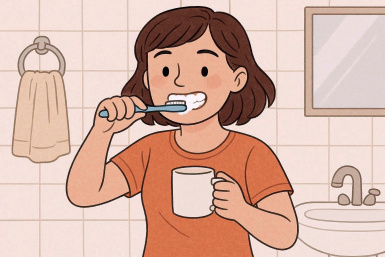
| se brosser les dents | to brush one’s teeth |
| prendre le petit déjeuner | to have breakfast |
| aller au travail | to go to work |
| déjeuner | to have lunch |
| travailler | to work |
| rentrer à la maison | to go home |
| préparer le dîner | to prepare dinner |
| dîner | to have dinner |
| se détendre | to relax |
| regarder la télévision | to watch TV |
| se coucher | to go to bed |
Examples
| À quelle heure te lèves-tu le matin ? | What time do you get up in the morning? |
| Je me lève tôt le matin. | I get up early in the morning. |
| À quelle heure prenez-vous votre petit-déjeuner ? | What time do you have breakfast? |
| Nous prenons le petit-déjeuner à 8h00. | We have breakfast at 8:00 AM. |
| Il travaille du lundi au vendredi. | He works from Monday to Friday. |
| À quelle heure vas-tu au travail ? | What time do you go to work? |
| Vous dînez à quelle heure ? | What time do you eat dinner? |
| Elle se couche à 22h00. | She goes to bed at 10 PM. |
| Je me brosse les dents le matin. | I brush my teeth in the morning. |
| Je déjeune l'après-midi. | I eat lunch in the afternoon. |