Adverbs of Manner

Introduction
In this lesson you'll learn how to use adverbs of manner to describe how an action happens. Chapter 3 of the story "A New Life in Vancouver" is included in this lesson as well.
Adverbs of Manner
An adverb of manner describes how an action is done. It gives more details about a verb. Most adverbs of manner are formed by adding -ly to the end of an adjective. for example, quick → quickly.
How to Form Adverbs of Manner
-
Add -ly to the end of most adjectives
quick → quickly जल्दी से slow → slowly धीरे से quiet → quietly चुपचाप -
Adjectives ending in -y drop the y and add -ily
easy → easily आसानी से happy → happily आनंद से -
Adjectives ending in -le drop the e and add -ly
possible → possibly संभवतः gentle → gently धीरे से -
Irregular adverbs
good → well अच्छा hard → hard कठिनाई से, कड़ी मेहनत से fast → fast तेजी से
Note: Hardly means not very much or not at all.
Sentence Structure
Adverbs of manner usually come after the verb and after the object of the sentence if there is one.
| She speaks slowly. | वह धीरे-धीरे बोलती है। |
| He opened the door quietly. | उसने दरवाज़ा चुपचाप खोला। |
To emphasize the adverb, it can be placed before the verb.
| She carefully checked the answers. | उसने ध्यान से उत्तर जांचे। |
| Examples | हिन्दी |
|---|---|
| The students worked hard. | छात्रों ने मेहनत से काम किया। |
| He answered politely. | उसने विनम्रता से उत्तर दिया। |
| They laughed loudly. | वे जोर से हँसे। |
| She quickly finished her homework. | उसने जल्दी से अपना होमवर्क पूरा किया। |
विज्ञापन
Chapter 3: Exploring by Bike
Vocabulary
| second-hand | सेकंड हैंड |
| residential street | आवासीय सड़क |
| reliable | विश्वसनीय |
| handlebars | हैंडलबार |
| steep | खड़ी |
| to catch ones breath | किसी की सांस पकड़ने के लिए |
| to pedal | पेडल करने के लिए |
| view | दृश्य |
| possibility | संभावना |
| to bloom | खिलना |
Story
Ana and Alejandro were eating lunch in the kitchen when Eric walked in.
"I found two second-hand bikes that you might like. Would you like to go see them?"
Ana smiled. “We’ve been wanting bikes since we arrived.”
They walked together to a quiet residential street where an older couple was selling bicycles from their garage. One was a dark blue hybrid with smooth tires; the other was a silver commuter bike with a small bell attached.
“These are perfect,” Ana said, running her hand along the handlebars.
Eric nodded. “They’re simple, but reliable. And Vancouver has great bike lanes.”
"It's a great day for a bike ride," Alejandro said after they had puchased the bikes. "Let's go explore the city."
"Just remember that the city is hillier than it looks," Eric warned.
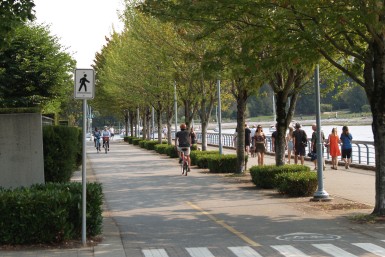
At first, everything felt easy. The bike lane was wide and painted a bright green, and the morning air carried the smell of cedar and ocean. They rode past cafés, small parks, and quiet houses with blooming gardens.
“This is amazing,” Ana said. “It’s smoother than I expected.”
Eventually the road tilted upward, just a little at first, but then became steep.
"Is this normal?" Alejandro said, out of breath.
Eric laughed gently. “Welcome to Vancouver. The hills are part of the experience.”
Ana stood on her pedals, pushing hard. “This hill is steeper than it looked from the bottom.”
"I didn't realize I was so out of shape," Alejandro replied.
They reached the top eventually—tired, sweating, but proud. The view opened in front of them: the mountains rising in the distance, the ocean shining below, and the city stretching out in soft morning light.
“It’s beautiful,” Ana said, catching her breath.
“It’s worth it,” Alejandro agreed.
Eric smiled. “That’s the thing about biking here. The climbs are tough, but the views are better than anything you get in a car.”
They rode again, this time downhill. The wind rushed past them, cool and bright. The city felt open, full of possibility.
When they reached home, Ana leaned her bike against the porch. “I love this,” she said. “Even if the hills are harder than I expected.”
Alejandro nodded. “We’ll get stronger.”
Eric locked his own bike. “You already are.”
The afternoon settled around them—quiet, warm, and full of the sense that they had taken another small step into their new life.
Quiz
Fill in the blank with the correct form of the verb in parentheses.