German Personal Pronouns
In this lesson of Learn German, you'll learn how to use the personal pronouns in the German language.
You'll also learn some more useful German phrases that are used in everyday life.
A short conversation is included to help you improve your comprehension of the German language.
Flashcards and a quiz are included to help you learn the words and phrases included in this lesson.
Advertisement
Ein Jahr in München
Here is the third chapter of the story "Ein Jahr in München", where Eric and Elena explore the neighborhood where their aunt and uncle live.
Vocabulary
| noch | still |
| früh | early |
| neugierig | curious |
| sagt | says |
| frühstücken | eat breakfast |
| Alles schmeckt gut. | Everything tastes good. |
| nach | after |
| Luft | air |
| Die Straßen sind ruhig und schön. | The streets are calm and beautiful. |
| bunte Häuser und viele Fahrräder | colourful houses and many bicycles |
| fragt | asks |
Kapital Drei: Der erste Tag in Schwabing
Es ist der erste Morgen in München. Elena und Eric wachen früh auf. Sie sind noch ein bisschen müde, aber sehr neugierig.
Sie frühstücken mit Tante Helga und Onkel Klaus. Es gibt Brot, Käse, Marmelade und Kaffee. Alles schmeckt gut.
„Guten Morgen, München“, sagt Elena und lächelt.
„Heute sehen wir Schwabing“, sagt Eric.
Nach dem Frühstück gehen Elena und Eric nach draußen. Die Luft ist frisch. Die Straßen sind ruhig und schön. Viele Bäume machen Schatten.
Sie gehen langsam durch das Viertel. Sie sehen kleine Cafés, bunte Häuser und viele Fahrräder. „Schwabing ist sehr gemütlich“, sagt Elena. „Ja, und sehr grün“, sagt Eric.
Sie kommen zu einem kleinen Park. Kinder spielen. Ein Hund läuft über das Gras. Elena und Eric setzen sich auf eine Bank. Sie hören die Stadt, aber es ist trotzdem ruhig.
Dann gehen sie weiter. Sie sehen eine Buchhandlung, eine Eisdiele und viele kleine Läden. Elena kauft ein Postkarten‑Set. Eric kauft ein Wasser. Sie lachen viel und machen Fotos.
Am Nachmittag gehen sie zurück zum Haus. Tante Helga kocht ein leichtes Mittagessen. „Wie war euer Spaziergang?“, fragt sie. „Sehr schön! Schwabing gefällt uns“, sagt Elena.
Am Abend sind Eric und Elena müde, aber glücklich. Es war ein langer, neuer Tag. Sie freuen sich auf morgen.
Pronouns
Using pronouns correctly in German can be a bit difficult for an English speaker. If you are just starting to learn German, don't worry about memorizing all of the different forms that the pronouns can have. You'll get a lot of practice with them throughout this course. Just be aware that the different forms exist. You can always come back to this lesson as a reference.
Pronouns are words that can replace a noun or noun phrase in a sentence. For example, it is a common English pronoun. Examples are given in this section to show how the German pronouns are used in sentences.
Pronouns in German have different forms depending on whether they are the subject, object, or indirect object of a sentence. Since German nouns have either a feminine, masculine, or neuter grammatical gender, the version of it to use depends on the gender of the noun it replaces. A feminine noun is replaced by sie, a masculine noun is replaced by er and a neuter noun is replaced by es. If the gender of an object is unknown, then es is used as the pronoun.
Subject Pronouns
The subject of a sentence refers to who or what is doing the action in a sentence, or what the sentence is about. For example, in the sentence I go, I is the subject. I is an English subject pronoun, so will always be the subject of a sentence. The subject is also called the nominative.
The following table shows the German subject pronouns, along with the English equivalent.
| ich | I |
| du | you (referring to one person) |
| sie | she, they |
| er | he |
| es | it |
| wir | we |
| ihr | you (referring to more than one person) |
Du, Ihr, and Sie
Du is the familiar singular form of you in German. It is used when adressing one friend, close family member, or child.
Ihr is the familiar plural form of you. It is used when talking to more than one friend, close family member, or children.
Sie is the formal version of you and is used to address any number of people. If unsure, this is the version that you should use. Sie is always capitalized when it means you.
Direct Object Pronouns
The direct object of a sentence refers to what is being acted upon by the subject. The direct object is also called the accusative.
For example, in the sentence I saw him., him is the direct object and refers to who is being seen.
The following table shows the German direct object pronouns, along with the English equivalents.
| mich | me |
| dich | you (referring to one person) |
| sie | her, them |
| ihn | him |
| es | it |
| uns | us |
| euch | you (referring to more than one person) |
Indirect Object Pronouns
An indirect object refers to the person or thing that is the recipient of the action, or who the action happens to. The indirect object is also called the dative.
In the sentence:
I gave it to him.
I is the subject (who is doing the giving), it is the direct object (what is being given), and him is the indirect object (the person who is the recipient of the action).
The following table shows the German indirect object pronouns, along with the English equivalents.
| mir | (to) me |
| dir | (to) you (referring to one person) |
| ihr | (to) her, them |
| ihm | (to) him |
| ihm | (to) it |
| uns | (to) us |
| euch | (to) you (referring to more than one person) |
| ihnen | (to) them |
Note: Ihnen is also used as the polite form of the indirect object for the pronoun you. In this case it is always capitalized.
Pronoun Forms Summary
The following table lists all the subject, direct object and indirect object versions of the German personal pronouns.
| Subject | Direct Object | Indirect Object | English |
|---|---|---|---|
| ich | mich | mir | I |
| du | dich | dir | you (one person informal) |
| Sie | Sie | Ihnen | you (formal) |
| er | ihn | ihm | he, it |
| sie | sie | ihr | she, it |
| es | es | ihm | it |
| wir | uns | uns | we |
| ihr | euch | euer | you (plural informal) |
| sie | sie | ihnen | they |
| wer | wen | wem | who |
Examples
 Gib sie mir.
 |
Give them to me. |
|
Willst du es?
|
Do you want it? |
|
Wer ist das? |
Who is that? |
|
Kommst du mit uns? |
Are you coming with us? (informal singular) |
|
Kommen Sie heute?
|
Are you coming today? (formal) |
|
Kommen sie heute?
|
Are they coming today? |
|
Ich sah ihn.
|
I saw him. |
|
Sie sah mich.
|
She saw me. |
|
Wir sahen sie.
|
We saw her/them. |
|
Wir sahen Sie. |
We saw you. (formal) |
|
Habe ich dir davon erzählt?
|
Did I tell you about it? |
Advertisement
German Phrases
Here are some more very useful German phrases. See the lesson Useful German Phrases for even more useful everyday phrases.
|
Wo wohnen Sie?
|
Where do you live? |
|
Ich wohne in ___. |
I live in ___. |
|
Keine Sorge! |
Don't worry! |
|
So bald wie möglich.
|
As soon as possible. |
|
Ich weiß nicht.
|
I don't know. |
|
Was ist das?
|
What is that? |
|
Wer ist das?
|
Who is that? |
|
Was ist los?
|
What's wrong? |
|
Was ist passiert?
|
What happened? |
|
Was bedeutet das?
|
What does that mean? |
|
Keine Ahnung.
|
No idea. |
Flashcards
Here are some flashcards to help you learn the German pronoouns and phrases introduced in this lesson.
German Conversations
Read and listen to the following conversation between Anja and Hannah.
German
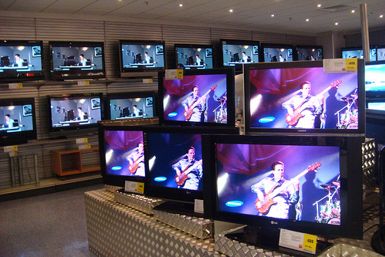
Anja und Hannah schauen sich in einem Geschäft neue Fernseher an.
Anja: Das ist ein schöner Fernseher.
Hannah: Er ist im Angebot für nur 250 Euro.
Anja: Das ist ein tolles Angebot!
Hannah: Guck mal, wie groß der Fernseher ist.
Anja: Der ist bestimmt sehr teuer.
Hannah: Ja, und meine Wohnung ist sowieso zu klein.
Anja: Lass uns in ein paar andere Geschäfte gehen.
English
Anja and Hannah are in a store looking at new televisions.
Anja: That's a nice TV.
Hannah: It's on sale for only 250 euros.
Anja: That's a great deal!
Hannah: Look at how big that TV is.
Anja:I bet it's very expensive.
Hannah: Yeah, and my apartment is too small anyway.
Anja: Let's check out some other stores.
German Pronouns Quiz
This quiz covers the German pronouns and phrases included in this lesson. Each time you take the quiz the questions will be a bit different.